Holder overrides
Connect to a Data Holder that does not follow a standard, without changing how any other registration behaves.
Holder overrides are available from Open Gateway v4.0.1. Earlier releases do not have them.
A holder override is a named behaviour that Open Gateway (OG) switches on for one registration when its Data Holder does not follow a standard and the connection cannot be made without a workaround.
Holder overrides:
- are off by default.
- are set per registration. Turning one on changes no other registration.
- take effect for new requests straight away.
- are turned on and off in OG Admin by a user with the OG Admin registrations write role (
biza-au:og:{STAGE|PROD}:registrations:write). - are recorded in the audit log every time one is turned on or off.
The catalogue of holder overrides is general. A holder override can be switched on for any registration of any holder.
Turn a holder override on or off
-
In OG Admin, open Registrations and select a registration.
-
On the Registration Detail page, find the Compliance overrides card. It lists each holder override with a switch.
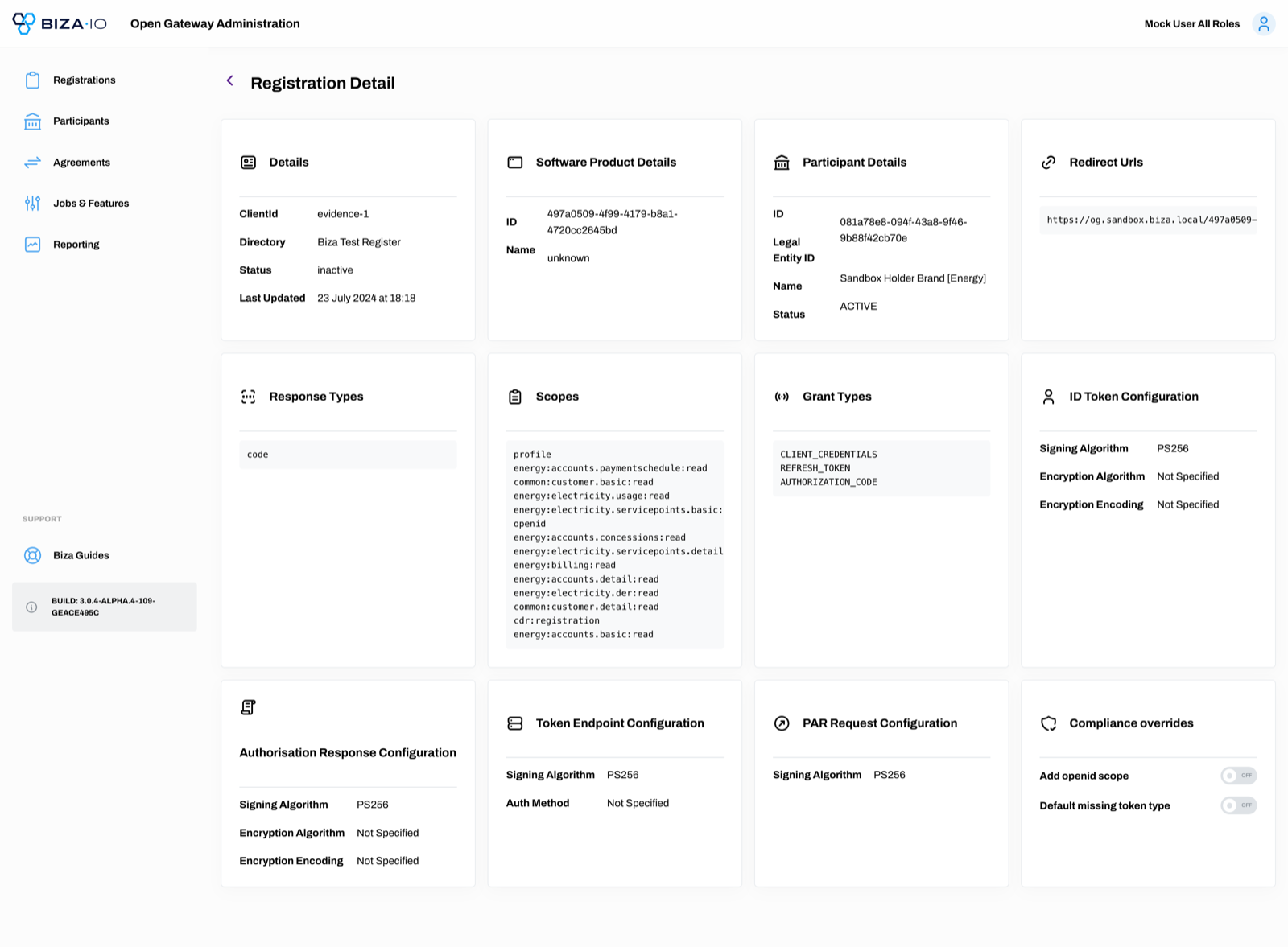
The Compliance overrides card. Both holder overrides are off by default.
-
Use the switch next to the holder override. OG Admin asks you to confirm, describes what the holder override does, and says the change is recorded in the audit log.
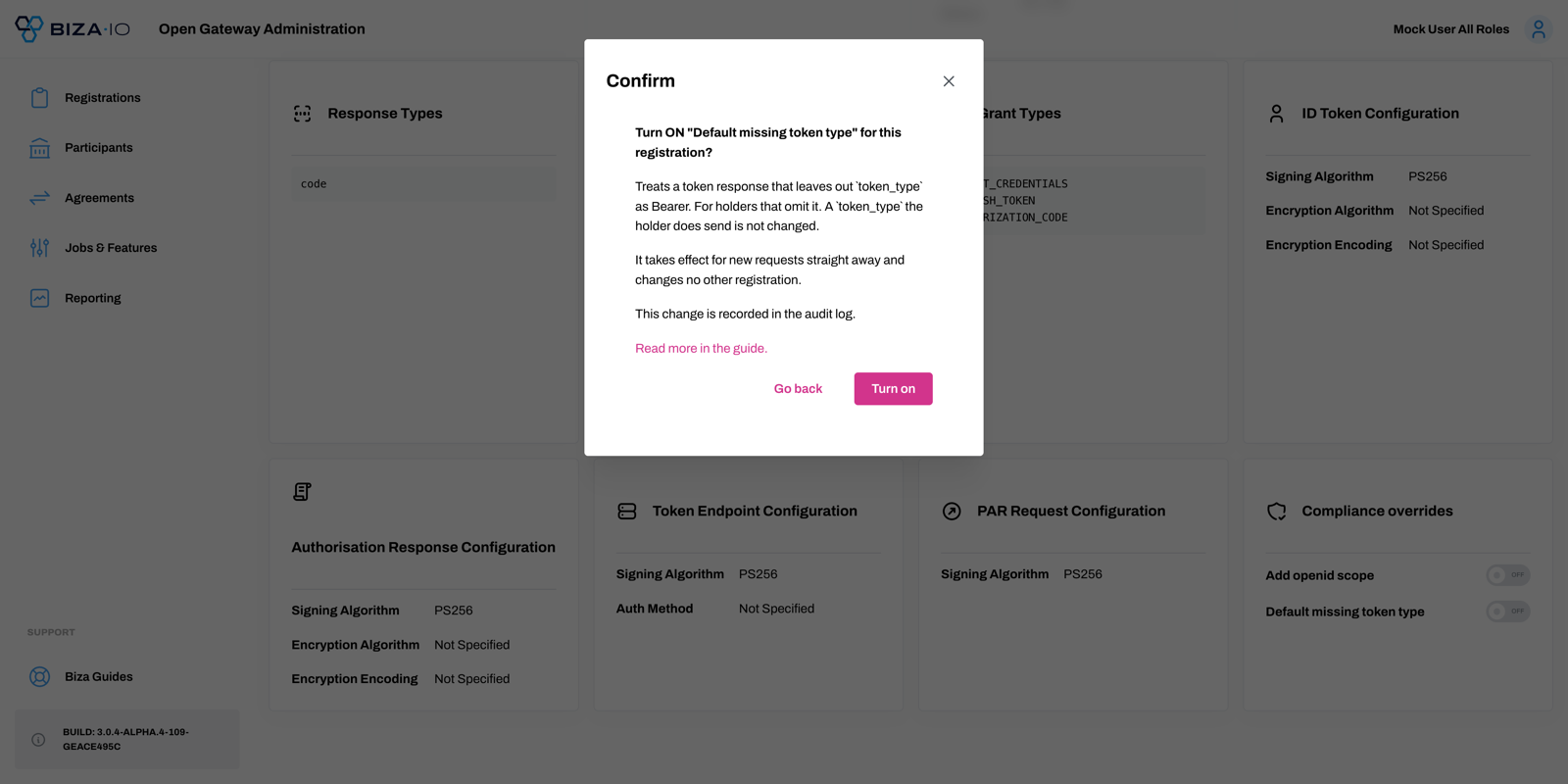
The confirmation dialog when turning a holder override on.
-
Select Turn on (or Turn off). OG Admin confirms that the override is saved.
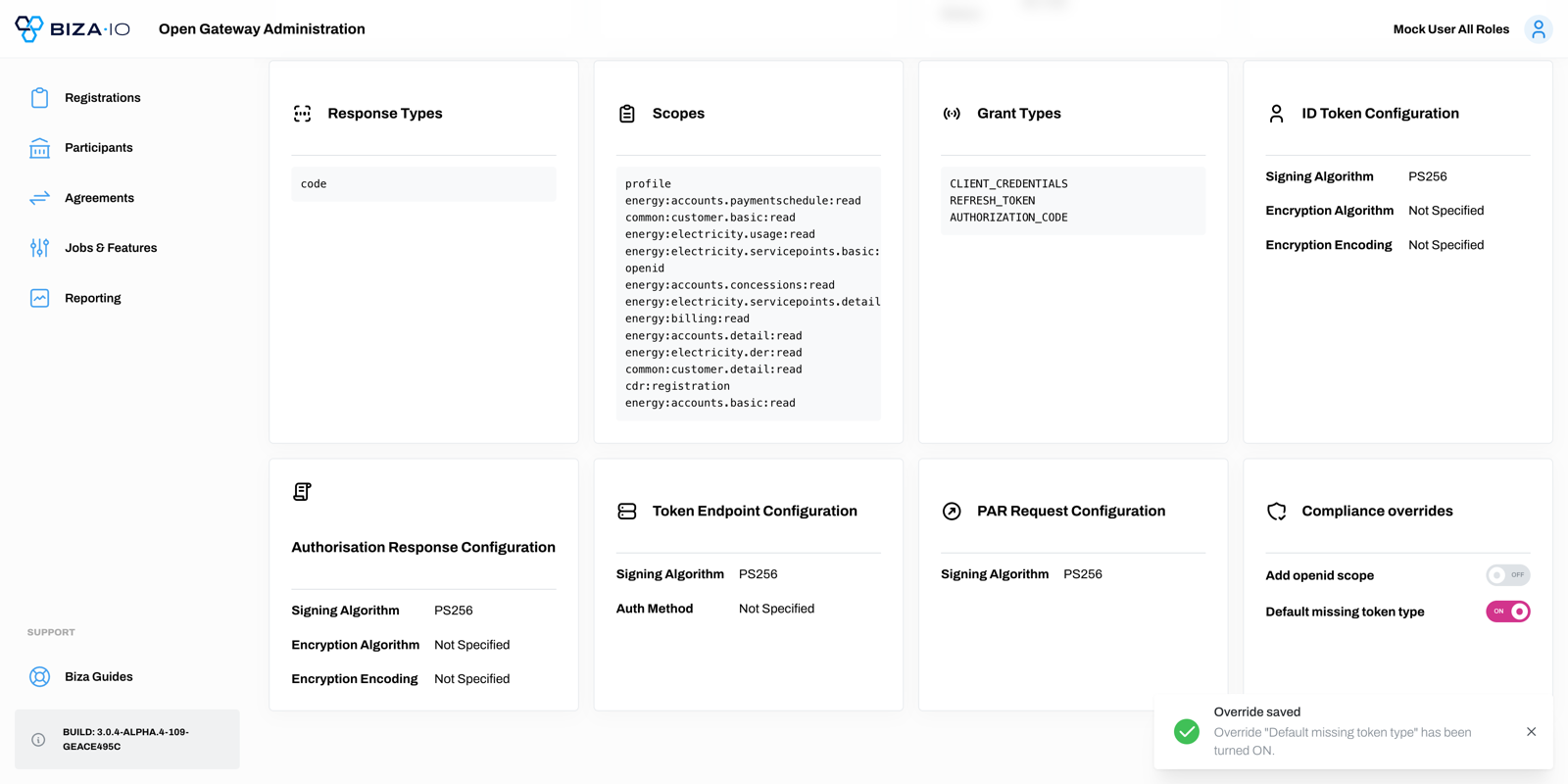
The holder override is on, and the change is saved.
Anyone who can open the registration sees the card. Confirming a change needs the write role. A user without it is sent to the unauthorised page and nothing is changed.
Add openid scope (ADD_OPENID_SCOPE)
The standard the holder does not meet
The Consumer Data Standards (CDS) require Data Holders to support the FAPI 1.0 Advanced profile. FAPI 1.0 Advanced section 5.2.2 says the authorization server "shall only use the parameters included in the signed request object passed via the request or request_uri parameter". RFC 9101, section 6.3 says the same: "The authorization server MUST only use the parameters in the Request Object, even if the same parameter is provided in the query parameter."
The OpenID FAPI conformance suite tests this: a request that carries only client_id and request_uri must succeed (fapi1-advanced-final-par-without-duplicate-parameters).
A holder that needs this override returns HTTP 400 when scope is not on the query of the authorization redirect.
What it enables
Adds scope=openid to the redirect that sends the customer to the holder to approve a consent. For holders that reject the redirect without it. Nothing else in the request changes.
What it does not change
- The signed request object keeps its full list of scopes.
- Nothing else in the request changes.
Default missing token type (DEFAULT_MISSING_TOKEN_TYPE)
The standard the holder does not meet
RFC 6749, section 5.1 says token_type is REQUIRED in a successful token response. A holder that needs this override leaves it out.
The CDS has no sentence of its own on token_type. It points to OAuth 2.0 and OpenID Connect Core for tokens and the token endpoint: "The requirements for the Token endpoint are specified in section 3.3.3 of [OIDC]."
What it enables
Treats a token response that leaves out token_type as Bearer. For holders that omit it. A token_type the holder does send is not changed.
What it does not change
- A
token_typethe holder does send is handled exactly as it is without the holder override. - No other part of the token response changes.
Turning it off
Turning DEFAULT_MISSING_TOKEN_TYPE off makes refreshes fail for consents connected while it was on, until it is turned back on. Nothing is lost. The CDS say Data Holders "MUST NOT cycle refresh tokens (rotation)", so the stored refresh token stays valid and refreshes resume once the override is back on.
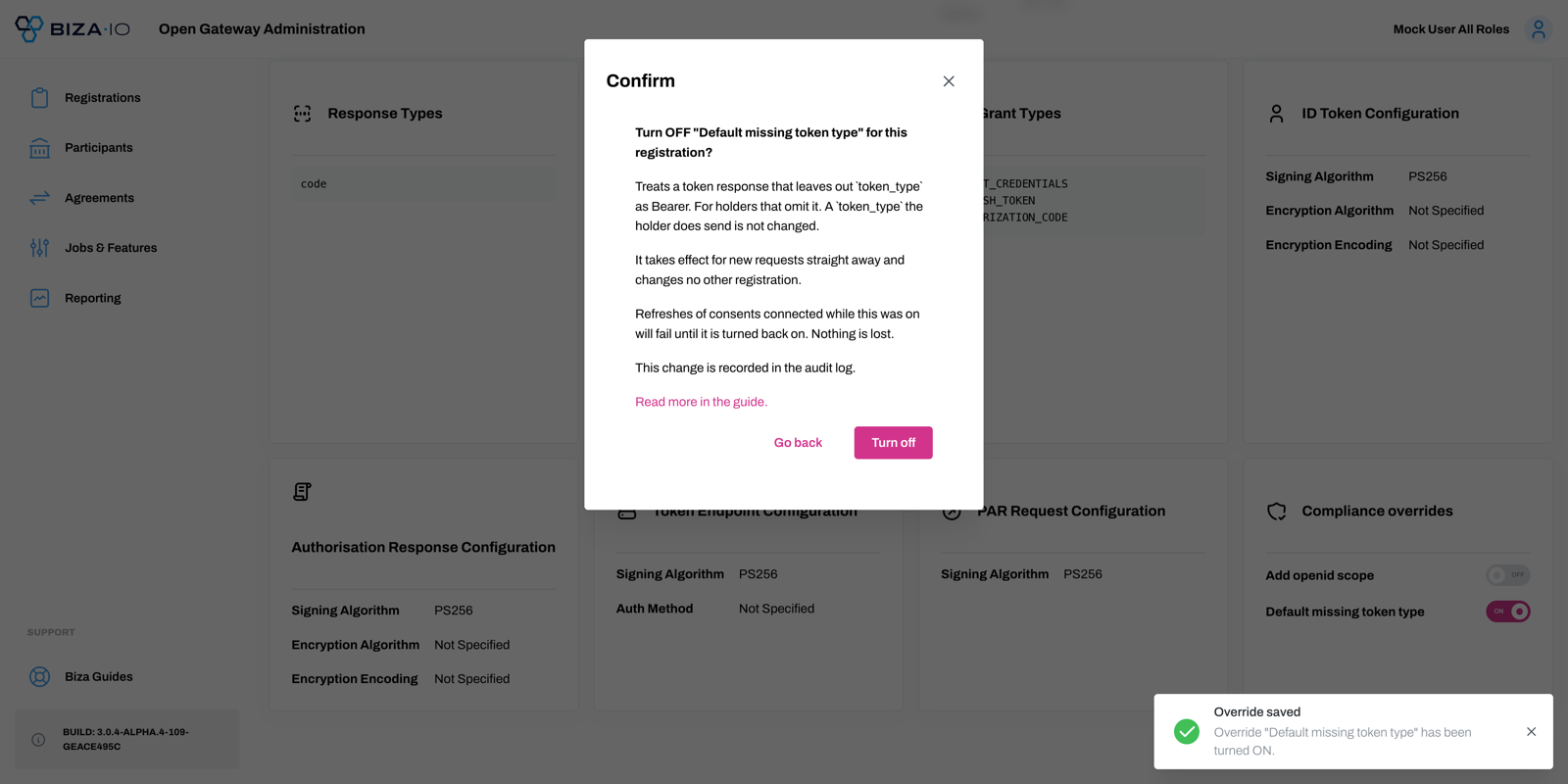
Turning DEFAULT_MISSING_TOKEN_TYPE off warns that refreshes fail until it is turned back on.
Related
- Open Gateway v4.0.1 Release Notes: the release that added holder overrides.
- Open Gateway Admin
- Client Registration